Showing posts with label Pilot 78G. Show all posts

Wednesday, November 11, 2009

Quo Vadis Habana Notebook: A Review


Here is the Quo Vadis Habana notebook from the kind people at Exaclair, Inc.

Those close to me know how much I love pens and notebooks. I always have a lot of both – in my backpack, on my office table, on my work table at home; even my closet has pens and notebooks inside! I think most of my backpack’s weight is not because of my laptop and its accessories but because it’s always full of pens and notebooks. And like most notebook enthusiasts, I currently have a number of notebooks in use – and four are in my bag. One of them is a black 6”×9” Quo Vadis Habana notebook.


The Quo Vadis Habana notebook.

Karen Doherty of Exaclair, Inc. has kindly sent me a large Quo Vadis Habana notebook in September. I kept my Quo Vadis Habana in its plastic wrap until I was ready to write the review because I was scared of any damage or dirt getting in the notebook. The first thing I did when I took out the plastic wrap was to smell the Habana's paper. Oh, yes I did that! I always do that to my notebooks, especially the newly opened ones. I do that because I love the smell of new paper, and partly because I also want to assess its quality. And yes, nothing beats the sweet smell of clean, new, non-acidic paper!


The Habana's bright white pages stay flat when the notebook is open.

The Quo Vadis Habana’s cover is made of black leatherette that gives it a subtle elegance. Wrapped in this leatherette is a thick but flexible board. I’m sure one can easily bend the covers, but I won’t risk doing that to my notebook. As I ran my fingers on the Habana’s front and back covers, it felt soft and smooth. The pressed QV logo on the front’s lower right corner and at the back signifies quality to me. My work background tells me these logos come from high quality leather pressing/embossing.


Elegant pressed QV logos on the Habana's front and back covers.

Inside the Quo Vadis Habana notebook are 80 sheets of acid- and chlorine-free, bright white, premium 90g Clairefontaine paper. Think of all that paper goodness! I am so amazed with the brilliant white pages and their smoothness. The lines are widely-spaced, and this is good news for me because of my fondness for wide strokes when writing. The notebook’s pages have round corners, and for me, this is a thoughtful gesture from QV for their notebooks’ users because sharp page corners not only tend to curl up, they can also cut into people’s palms.


Round page corners on the Habana's pages.

The Quo Vadis Habana notebook’s binding is another plus for this notebook, because it allows the pages to stay flat on their own while the notebook is open. This is shown in the photo above of the open notebook.


Notebook abuse? Nah. It was only a test that the Habana gracefully passed.


Finally, we come to the best part: the writing samples!

Because all the reviews raved on the Quo Vadis Habana’s ability to hold fountain pen inks, I tried all my wet nibs on it. I wrote with all my italic/calligraphy pens, some o f my medium nibs and two of my wet fines. The results? Amazing!

I started write-testing the Quo Vadis Habana notebook using my italic nibs. Then I used three Parkers inked with highly saturated inks: Private Reserve Copper Burst and Avacado. Lastly, I wrote with my other inked pens, starting with my Retro 51, which is a wet medium inked with a wet ink: Waterman South Sea Blue. I tested my other mediums, the Parker Rialto and all three Schneider Base pens, the first filled with CdA Saffron and the others with either J. Herbin Bleu Pervenche or Rouge Opera. I also tried the bold Pilot 78G and two plastic pens I got from Daiso, both with scratchy nibs but gives out very wet ink flow. All writing samples looked beautifully, all ink samples dried fast, and because of the Habana’s white paper, the colors all looked so bright! My momentary surprise was cut short when I remembered I had to check the Habana for two more things: feathering and bleed. There is absolutely no feathering on the Habana from all the pens and ink colors I used. Hurray! Bleed? It’s almost as if I held my breath as I turned the page over so I could check for bleed. And… voila! Absolutely, definitely, certainly no bleed at all! Hurray! This means I can forever use a fountain pen to write on my Habana notebook, right?

Pen and ink combinations


Schneider Creativ 1.5mm italic nib and PR Avacado; Lamy Joy 1.5mm nib and CdA Saffron.


Lamy Vista (1.9mm) with Bleu Pervenche, Lamy Safari (1.1mm) with Rouge Opera and Lamy Joy (1.5mm) with CdA Saffron.


3 Parkers: Parker 25 (M) and Parker Jotter (M) with PR Copper Burst, and Parker Vector (wet F) with PR Avacado.


The rest of all the pens and inks I tested on the Habana.

But, wait! I’m surely happy and excited to use the Quo Vadis Habana notebook for journaling, but there are two things I hope the people behind QV will consider: the elastic closure and the page marker ribbon.

The elastic closure for me seems too narrow for this notebook size. Some users may like thinner bands such as the one on the large Quo Vadis Habana notebook, but I would have liked mine to be a little wider. Perhaps this size is good for smaller notebooks, but for a 6”×9” leather-covered journal, it looks a bit awkward for me.

I feel the same for the Quo Vadis Habana notebook’s page marker ribbon: it is too narrow/thin, and too short for the 9” page size. The ribbon is a bit short for me that I cannot tie its end to prevent fraying or I will shorten it even more. But that’s just me, and that doesn’t mean I love the Habana less. :)


The Habana's page marker ribbon which I feel is too thin and narrow. Again, that's just me! :)

The Quo Vadis Habana is a great notebook, and probably the best I’ve ever tried. It’s already friends with my fountain pens, has excellent paper, looks great, what more could I ask for? (Just a wider elastic band and longer page marker ribbon. LOL!) Perhaps a notebook for each available color? Or one of each size? The Habana is available in four colors: black, which is the one being reviewed here; blue, red, and taupe; and in two sizes: large (6"×9", with 80 sheets of 90g paper), and pocket (4"×6", with 96 sheets of 64g paper). Hmmm... Lots of notebooks to choose from! More information about Quo Vadis Habana notebooks is available at the QV site.

Lastly, I’d like to give Mr. Pythagoras a bit of a show-off here.


Sunday, October 25, 2009

B is for Bold

And we're now back to regular programming... Err, pens. Yes, we're back to the topic of pens.

As a newbie FP collector, I read (and heard) a lot about Pilot 78Gs as being excellent starter pens. I thought the pens looked simple and unpretentious but I liked that because it made them look classy and neat.

During my first pen meet, I saw my fellow Pinoy fountain pen collectors getting their 78Gs from Sir Butch Dalisay who brought a couple of the pens for them from his Shanghai trip (I got a black Hero 616 from that giveaway, though). And then I read about 78Gs from the FPN forums and good reviews from a lot of pen and paper blogs, but the best are from my good friend Tom and Paul David Krishnan's Phase Ignition.

My Pilot 78G B rests on the rim of my Cusco, Peru shotglass. Another opportunity to mix the stuff I love to hoard: pens and shotglasses. :)

After months of waiting, I made it to Cosmos Bazaar in Binondo, a store recommended by Pidoy Velez, another Pinoy FP collector, and found a couple of 78Gs with medium and fine nibs among a vast selection of other Pilot pens. Typical hoarder that I am, I bought all available colors with medium nibs: black, teal, green. A medium maroon was not in stock so I wasn't able to complete the four-color set, but that's okay. I inked the black pen as soon as I got home, and I was disappointed that despite being a medium, I was not satisfied with how it wrote. I realized that in nib language, Japanese medium becomes a Western fine (or even extra fine). I don't have anything against that, a lot of FP users prefer fine or extra fine nibs, but I am a medium nib user. I always find my writing to be uncomfortably ugly when I use thin nibs. I want wide strokes using broad, bold and wet nibs.

I knew Pilot 78Gs are also available with broad/bold (B) and double broad/bold (BB) nib, yet I couldn't possibly think of a way of getting one. But I had to get one. It's amazing that while chatting with Tom one time, I asked him if he happened to have a 78G with a B nib. And he has! :) Tom kindly sent the pen to me right away. Hurray! Applause!

The black broad/bold 78G did not look any different from the black medium pen I inked earlier, except for its nib. The pen is made of plastic, yes, but still looked classy to me. I don't mind the gold-plated metal clip and the two gold bands near the cap rim. Who cares? I got a classy pen that writes smoothly and that's all that's important, I guess.

The Pilot 78G B. Above: Barrel with the Pilot sticker on, and section with the converter. Below: the pen's cap and barrel.

The name Pilot is imprinted downwards on the clip, and Japan is printed on the back side of the cap, breaking the wider of the two gold bands. The nib is almost a stub, and looking at it through a 10x loupe shows its tines properly aligned. This pen, like the ones before it, has an aerometric filling system, but further reading says it can also be inked using international cartridges. The pen is very light owing to its plastic body, and that makes it easy to hold when writing. Cleaning it is a breeze because the nib assembly can be removed from the section with a slight but firm tug. (Thanks to John Raymond Lim and Mona Caccam for the useful information.)

The section when I fully diassembled it. The pen part on top is the converter. Parts below, from left: nib, feed, and section barell.

Oh, what more can I say about this great pen? I'm happy to have it now that I'm learning to write italic and script. Below is a writing sample using the broad/bold/stub 78G inked with Lamy Black.


And again, as my small token of gratitude for the help extended to me so I can get and enjoy this pen, here's to you, Tom! :)

Friday, August 7, 2009

The Search is (Almost) Over

... for the (almost) perfect paper for my pen reviews.

I must admit that I'm new to this gel pen review stuff and it's an exciting project. My first three reviews were well-received, but I felt that somehow, something is still missing. Until I saw The Pen Addict's Signo review recently. I noticed that for all his reviews, The Pen Addict used the same paper, where he wrote with the pen being reviewed. And he only used a single photo: the pad (with his review written in longhand) and the pen. After reading that post, and seeing other pen reviews, I knew what I wanted to do with my reviews.

Not that I want to duplicate what The Pen Addict and other pen reviewers do, but I felt I could do something similar so I will have consistency in my reviews. I'll post more photos, of course, but I'd like to use just one pad, notebook, or paper type for my reviews. So during the weekend, I went out looking for a white, ruled pad that I can use to write on for my pen reviews. I had a very specific criteria in mind: 1) paper must be white so it won't interefere with ink colors; 2) paper must be ruled; 3) paper must resist feathering and bleed because I also plan to use it for my fountain pens.

As I browsed the stacks of various paper supplies at NBS, a pad caught my attention because of its blue lines. The 8x10in paper is immaculate white and the lines are printed in light blue. Think about Waterman South Sea Blue. Thickness is not very remarkable, but as an elementary pad paper, I don't think I should expect too much. I'm glad the paper is not shiny, which means it's not coated. After "feeling" the paper for some time, I went ahead and paid for it.

The Cattleya intermediate pad: heaven sent!

A closer look at the Cattleya pad's paper.

At home, I was like my four-year old niece in my excitement to try the new paper on my hands. I tried some of my gel pens first and it went well. No bleed, no feathering. I then took out my pen case and tried my inked daily warriors: medium Schneiders, Parkers, and Lamy Safari, Thein (my Frankenpen, a Sheaffer Thin Model), and Pilot 78G.

A test page showing different pens and inks on a page off the pad.

The ballpoints went okay, and writing is silky smooth, as is the gels and pencils. The Sharpies despite being ultra-fine points feathered and bled too much, but that's okay.

A closer look at the upper part of the test page.

Ballpoints, gels, markers, and pencils.

As I wrote the first line using my Schneider Base, I was super amazed - there wasn't any trace of feathering or bleeding even if the ink dried up fast! It looked (and felt) like I was writing with a ballpoint! (But only because the ink from my Schneider, a wet pen, did not feather or bleed.) I went to try my other pens as well - the very wet medium Lamy Safari, then my Parkers this time, and still, there wasn't any feathering or bleed! The long-awaited but tolerable bleed came when when I tried Thein, a medium Sheaffer. But that is okay, I guess. I've seen worse bleed on paper. :) And I must say that most of the FPs I tried fared better than the gels.

Here are the fountain pens, all with medium nibs: Lamy Safari (it should be M), Schneiders, Parker, Sheaffer and Pilot.

The back of the test page shows some "see-through", but it's not a bother at all. And I think some see-through (exhibited by some of the gels and fountain pens) is way better that the heavy bleed shown here by the Sharpies.

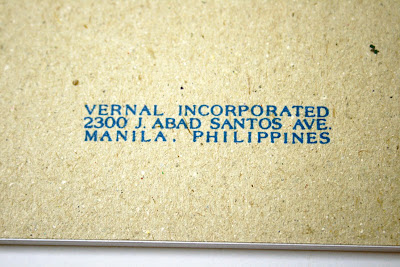
The pad's back board showing Cattleya's logo, its manufacturer and where it was manufactured.


And so the search for the THE (almost perfect) paper ended with with the Cattleya intermediate paper. Sold in pads of 90 leaves in 8x10in book paper, it's selling for PHP28.50, or approximately US$0.60! I will definitely go back to NBS this weekend and get more pads. This pad of paper is not only good for reviews, it's good for oodles and doodles too! Well, as another FPNP member said, the good stuff do not have to always be the expensive ones. *Wink.*